A new path in working life through LRO
Atso Koskinen
Pipefitter, Technical accommodation outfitting
Pipefitter Atso Koskinen’s working life has included many different fields and changes of direction. He found his way to the shipyard through Meyer Turku’s Shipbuilding School recruitment training. For Atso, who is used to working with his hands, the school’s training and work at the shipyard have turned out to be a perfect match.
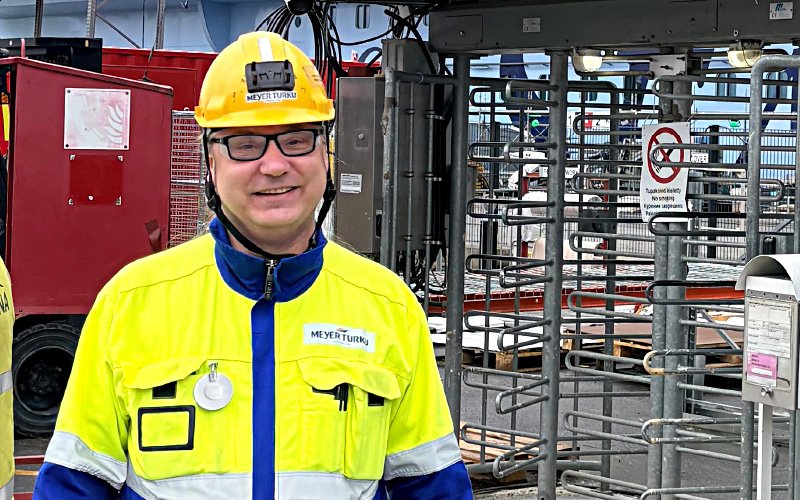
Atso Koskinen has been working in outfitting at the shipyard since early 2026. His path to the shipyard led through the Shipbuilding School’s (LRO) six-month course for ship pipe and engineer fitters. Before the course, Atso had already seen quite a bit of working life.
After graduating as a telecommunications mechanic in 1992, Atso first worked with mobile phones. From phones, he moved on to working in a diving shop and as a diving instructor. Next, he came back above the surface to work as a boat electrician, which he also did through his own company. After a few intermediate steps, Atso moved into procurement, completing a two-year training programme covering everything from the basics of the field to management. In 2022, Atso started working as a category manager for a department store chain. He applied to LRO in 2025.
– After working in retail, I was unemployed for a couple of years. I noticed that applications were open for LRO’s recruitment training programmes. When I was younger, I worked in production, and I’ve always been used to doing things with my hands through my hobbies, so I thought the training might suit me, says Atso.
Atso started the ship pipe and engineer fitter course in autumn 2025. The so-called PuKo line interested him more because of the technical nature of the work. According to Atso, LRO listens well to applicants’ wishes when selecting training lines. Overall, LRO’s practical training suited him very well, but in his view the best part was the readiness it gave him for working in the shipyard environment.
What the training requires above all is a willingness to learn. Some kind of manual skills are useful, but the basic skills are taught step by step.
– The training was an extremely good introduction to the job, and during it I became familiar with the world of the shipyard. It was easy to move on to the work placement and then to the actual job, because I already knew the practical side of the shipyard, Atso describes.
At the moment, Atso works in system commissioning in the shipyard’s outfitting department as part of a team of about ten people. The team’s main task is to monitor that systems such as the ship’s grey water and domestic water systems have been built correctly. No two working days are quite the same. At the stage when crew members are already living on board the ship under construction, the work also includes being on call in case one of the systems stops working. A major exception to everyday work was the sea trials of Legend of the Seas, which Atso took part in.
– The sea trials were a great experience, even though they definitely weren’t a pleasure cruise. During the trials, I got to know many new shipyard colleagues. Everyone had the same attitude during the sea trials, and the atmosphere was good, Atso says.
According to Atso, his current work in system commissioning is somewhat unusual for someone who has completed the PuKo line training. Because of that, he has had more new things to learn after the training than usual. But for Atso, who is used to learning new things, that has not been a problem, and he recommends LRO’s training programmes to anyone interested in working at the shipyard.
– For me, the training was only and entirely a positive experience. What the training requires above all is a willingness to learn. Some kind of manual skills are useful, but the basic skills are taught step by step. One piece of advice I would also give is to invest in your time at school. The better you do during the training, the better your chances are of getting into work tasks that suit you, Atso points out.